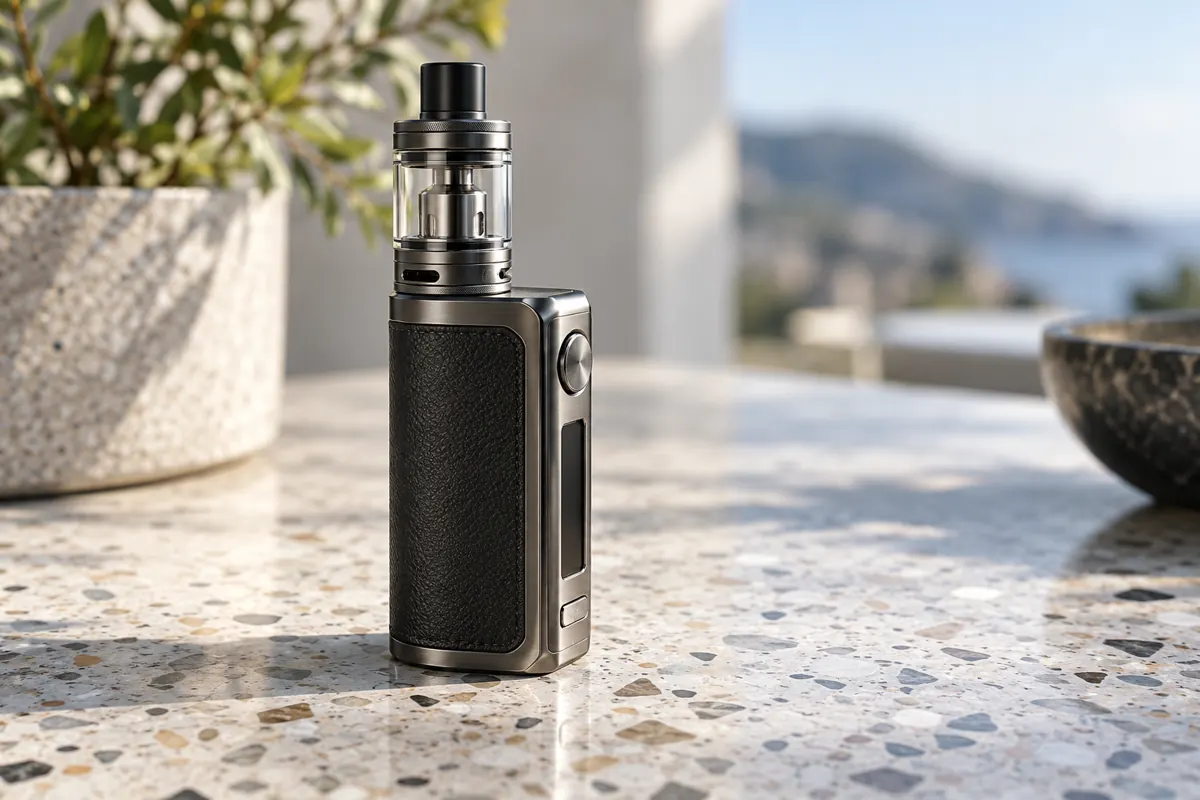
Vaporesso Armour GS, making it last like a box mod

A pod mod usually lives exactly as long as its battery. Once the cell fades, the whole device goes in a drawer, even when the screen, the chip and the shell are still fine. The Vaporesso Armour GS sidesteps that rule through one design choice that listings mention in a single line without drawing any conclusion. Its manual says rather more, about charging, heat and the chip’s safety cut-outs. It simply needs reading the way you would read the manual of a mod you intend to keep.
What keeps the Vaporesso Armour GS going
The Vaporesso Armour GS can outlast a pod with a built-in battery for a simple reason. It runs on a removable 18650 cell, sold separately, which you swap once it wears out, whereas its twin, the Armour G, has a 3000 mAh battery fixed inside the shell. The battery, often the first part to wear, becomes a consumable here.
Three habits complete that design choice. Charge from a power supply that matches the manual, stay within the temperature ranges it sets, and treat the pod and the GTX coils as parts to renew. Everything else, chip, screen and shell, then no longer depends on how the battery ages.
A pod mod built like a single-cell box mod
Vaporesso files the Armour GS under its pods, yet its layout borrows a lot from the box mod. The maker’s sheet gives the device as 126 x 39 x 28 mm, 13 mm taller than the Armour G, which is the room taken by the cell.
Output runs from 5 to 80 W, set from a 0.96 inch TFT screen with an LED light. That is the range of a small single-cell mod, and the manual has you fire it with the button, as on a box mod. The brand’s mod families, from GEN to Armour, are covered in our guide to the Vaporesso mods range.
Where it differs from a real box mod is the atomiser. The Armour GS only takes the Armour G Series pod supplied in the box, not a tank of your choice. The box holds the mod, that pod in its DTL version, a pre-fitted 0.15 ohm GTX coil, a spare 0.3 ohm coil, a USB-C cable, the user manual and a warranty card.
The Vaporesso Armour GS 18650 cell, the part that wears and gets replaced
On a device with a built-in battery, a tired cell ends the whole thing, and the series manual states that repairs go through Vaporesso only. On the Armour GS, the same wear is solved by changing the cell. The cell still needs choosing and checking.
Choosing a cell for the wattage
The full 80 W calls for an 18650 whose continuous discharge rating covers the current drawn at full power. Capacity alone is not enough, as a high-capacity cell often handles a lower current. Our feature on moving to a 21700 mod explains how to read that continuous discharge figure, and the same reading applies to an 18650.
Knowing when to take it out
The manual forbids using a damaged or leaking battery, and asks you to keep it away from metal objects that could cause a short circuit. A cell whose wrap is split, scratched down to the metal or peeling at the positive end therefore comes out of the device. Carried loose in a pocket with keys, a bare 18650 carries the same risk.
Charging the Armour GS without tiring the cell
The maker’s two documents do not give the same figure. The sheet lists USB-C charging at 5 V and 2 A, while the series manual caps the power supply at 5 V and 1 A. With no word from Vaporesso on the gap, the lower figure, the manual’s, remains the cautious one for the cell.
What the manual asks for
It only allows an external power supply of 5 V and 1 A at most, and only a charger certified to IEC/EN 60335 or IEC/EN 61558. A phone plug rated above 1 A falls outside that rule. While charging, the screen shows the battery level and the time remaining.
Charging in the device or outside it
Charging in the device works the USB-C port, a wear part on any mod. An external charger spares that port and lets you follow each cell on its own, which matches what a box mod is, and the parts that make it last.
The chip’s six protections, and what they prevent
The manual lists six protections built into the chip. They do not replace care, but they explain most of the cut-outs people mistake for a fault.
- USB input, against an excessive charging voltage.
- Low battery, with a cut-out when the charge runs too low.
- No load, when no pod is detected.
- Short circuit.
- Over-time, which stops a continuous fire lasting more than 10 seconds.
- Overheating of the circuit board.
A device that will not fire with a fresh pod is often pointing to a poor contact. The manual asks for the connection pins between pod and mod to be kept clean for that very reason.
Pods and GTX coils, the Vaporesso Armour GS consumables
The pod fills from the top once the silicone plug is lifted, and the airflow is set by turning its top cap. On capacity, the sheet lists 5 ml in the standard version and 2 ml in the TPD version. In the UK, refillable tanks and pods are capped at 2 ml, so the 2 ml TPD version is the one sold here, and nicotine e-liquid comes in 10 ml bottles of 20 mg/ml at most.
Retailers sell these Armour G Series pods in twos, compatible with the whole GTX range. A coil is changed by taking the pod off the mod, and the manual then asks you to wait 5 minutes after filling so the cotton can soak. That wait avoids heating the cotton of a new coil dry.
Vaporesso suggests 60 to 75 W for the 0.15 ohm GTX coil and 32 to 45 W for the 0.3 ohm. Above those ranges, the cotton dries faster than it soaks and the coil wears out before its time.
Temperatures for use and storage
The manual sets three temperature ranges that listings rarely repeat. They concern the cell as much as the electronics.
| Situation | Range given in the manual |
|---|---|
| Use | -10 to 60 °C |
| Storage | -10 to 45 °C |
| Charging the cell | 10 to 40 °C |
The charging range is the narrowest. A cell brought in from the cold is best left to reach room temperature before it is plugged in, and a device left in full sun behind a windscreen soon goes past the storage limit.
FAQ
Five questions that come up about the Armour GS and that the sections above leave aside.
How do you switch the Armour GS on and off?
Five quick presses on the main button, within 2 seconds, switch the device on or off. Three quick presses open the settings menu, where you find the modes, the power lock and the brightness.
Which coil comes fitted?
The 0.15 ohm GTX mesh coil, pre-installed in the pod. The second one, at 0.3 ohm, sits in the box. Both are aimed at direct lung vaping, the 0.3 ohm at a more moderate wattage.
What is the difference between Pulse and Eco modes?
Pulse mode works at constant voltage, to bring out flavour and throat feel according to the manual. Eco mode is the standard wattage mode, set to suit the coil, and the manual credits it with longer battery life than Pulse.
What does the Smart function do?
When it is switched on, it suggests a suitable wattage for the coil detected in the pod. The manual points out that it only works with the GTX coil platform.
Can you turn off the screen animation?
Yes. The settings menu has an Animate option, which switches the firing animation on or off, next to the Bright option that sets the brightness.
Vaporesso Armour GS, a pod mod that ages like a box mod
The Vaporesso Armour GS has the quality that matters most at the Fumoir, a power source you can replace. Its manual fills in the rest, with temperature ranges to respect, six protections that explain its cut-outs and charging held to 5 V and 1 A on a certified charger, where the sheet lists 2 A.
Looked after, the Vaporesso Armour GS can keep its chip and shell well beyond its first cell, as long as pods and coils are renewed. Reading a manual this way, one wear part at a time, works for any regulated mod.
Also in the lounge
- The Vaporesso mods range, family by family
- Moving to a 21700 mod, what the bigger cell really changes
- What a box mod is, and the parts that make it last
The Fumoir writes for adult readers only. Vaping products can contain nicotine, which is a highly addictive substance, and vaping products are not for sale to anyone under 18 in the UK. This editorial feature is not a buying recommendation.